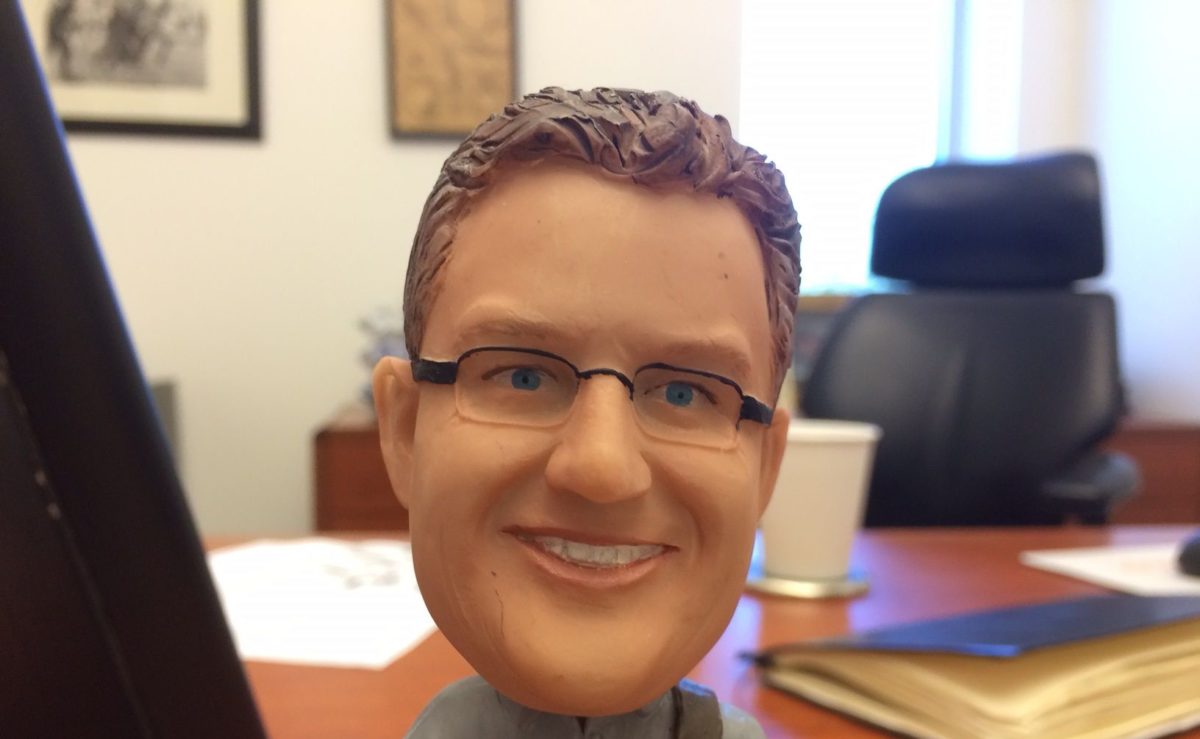
“Hello Cleveland”
Monday was the fist low humidity day in months and we took advantage by walking down to Aquila Bistro and Cafe. It’s only half a mile away and we haven’t been since it opened in what used to be the Rabbit’s Foot (a coffee shop that I really enjoyed.) The food and coffees were very good and the service excellent. We’ll put this back on the rotation – we have so many good coffee shops in walking distance, particularly as it starts to cool off a wee bit.


Diana got avocado toast which was served with tater tots (her number one comfort food), eggs and a salad. All very good. The shop had a clever item for sale – “A date with a puzzle.” These were jigsaw puzzles wrapped up with a description that included the number of pieces and three words to describe the subject. Maybe I’ll have to go back and get one for McD to do on a rainy day.
I’ve been working to step up my omelet game in retirement. Plenty of time for chives, avocado and radishes to spice up the presentation:

 We were planning to see the Spinal Tap II movie on Friday, followed by the “Hello, Cleveland” cover band. In anticipation we had Kenny, Kara, Thom, Libby and Jack over to watch the original movie on Monday night. The classic line from the original is that their amplifiers go to “11.” Diana helped me adjust mine to the same:

 Spinal Tap II was filmed mostly in New Orleans with cameos from Paul McCartney and Elton John. The cheese shop scenes were filmed in the store next to my barber, Aidan Gill, and he provided the “green room” for the day with Guinness and Irish whiskies. Diana and I wandered by and saw Rob Reiner directing the action in “Nigel’s Cheese Shop.”
I ordered up some coasters and a wee Stonehenge (plays a role in the original movie stage set) to make things fun.


We had a fish and chips dining theme (would have been better if Jack had remembered his freshly caught snapper) with malt vinegar and tartar sauce – the easiest British food we could come up with on short notice.
Here’s the trailer for Spinal Tap II – complete with the Stonehenge themed 2:
 I thought these beers were funny – came across them while shopping for Monday dinner with Jack “O”gan.
We seem to think we won trivia on Tuesday – there appears to be some confusion but we’re going with it. The only questions I knew were these two:

“Fuddy Duddy”

“Jimmy Johnson”
By the time I called Denny on Wednesday morning he had already heard from Jack that I was minimally helpful.
 We made it to the Hot and Soul restaurant next to the new Trader Joe’s for lunch on Wednesday. This is a single shotgun house and seemed to have an interesting menu. I enjoyed the veggie curry and Diana had a tasty ceviche. We sat at the bar and I was surprised when one of the cooks proceeded to chop up more than a dozen onions on a surface just behind the bar. I asked the bartender/waitress why he didn’t do that in the back instead of bringing tears to all of our eyes. I got what I’m sure she thought was a funny reply, but it just seemed rude and flippant to me. Not sure I’ll be rushing back to this place.


Diana led an expedition to the Banks Street Bar on Wednesday evening to listen to Mia Borders perform. This was a pleasant neighbourhood bar and Mia played a good set that started on time at 6pm – always appreciated by the old folks.


We split a burger from the place next door and enjoyed it with the music.
“Set It Up” was a funny movie that we watched later in the evening.
Zoey Deutch and Glen Powell were very entertaining.
I accompanied Diana to a doctor appointment on Thursday and then we made a visit to Octavia books – such a nice store and much expanded. I picked up the Tom Piazza book about his friendship with John Prine and “Buckeye” by Patrick Ryan. More to come on both of those soon.
We picked up Kenny and Kara for the Spinal Tap II excursion on Friday evening. Here’s how the Broad newsletter advertised the event:
“First up, on Friday night, we have a twofer of Spinal Tap bliss! At 7pm, we will screen the film at The Broad Theater, then immediately following, Broadside will host HELLO CLEVELAND, the greatest (and maybe only?) Spinal Tap cover band. Hello Cleveland is compromised of Marc Paradis on guitar, Beth Patterson on electric bouzouki-tar, Dave Pomerleau on bass, Mike Barras on drums, and Josh Paxton on keys (most of the members from Johnny Sketch and the Dirty Notes). Check-in will be at the theater where you will be given a wrist band to enter Broadside.”

The movie was very funny and well done – I enjoyed it even more than the first one. Diana was particularly entertained – haven’t seen her laugh as much at a movie ever. We both remarked that it was fun to watch a movie in a full theater with folks that were enjoying the humour.
The cover band of all-star local musicians was also very entertaining. What a lot of work those guys did for a one night only performance. Here are some highlights:
“Heavy Duty”:
The wonderful pianist, Josh Paxson, doing an intro to “Stonehenge”:
A couple of clips from “Stonehenge”:
Jeff was in town solo on Saturday to attend his Mom’s birthday on Sunday. Merry Lee had to attend a funeral. We met Jeff at the Rusty Nail (walking distance from his condo) to watch the LSU college football game.

We left at halftime and watched the conclusion (a nice win for LSU) from our respective homes. Jeff enjoyed the Rusty Nail and was excited that it was dog friendly.
 Diana joined me on a walk to French Truck coffee this morning. I realized on leaving that I had made quite a mess on the floor with my very flaky and delicious croissant.
I’m currently watching the Saints struggle to get anything going against the San Francisco 49ers. And there was just an update that the Cowboys (not on TV in New Orleans) are losing to the Giants. There’s still time for both teams to recover.

This article in the Tuesday newspaper reminded me of the literary geniuses that have inhabited New Orleans over the years:
William Faulkner spent a year in New Orleans. It influenced his writing all his life.
The Nobel laureate remembered the city with affection, saying he “had more fun there than I ever had and ever will have again anywhere.”

For aspiring writers, New Orleans in the 1920s wasn’t just another city; it was a cultural crucible where artistic voices were forged amid a tolerant, bohemian atmosphere. For William Faulkner, his transformative stay in the French Quarter in 1925 proved pivotal, marking his transition from an aspiring poet to a fledgling novelist and profoundly shaping his literary trajectory.
When Faulkner arrived in January 1925, a few months after his 27th birthday, he was only passing through on his way to Europe. But he quickly fell under the city’s spell, finding in its French Quarter a poor man’s Paris where he could live cheaply and richly among artists.
He rented a modest apartment in Pirate’s Alley (then Orleans Alley), today a literary landmark. This lean living situation was part of the Quarter’s allure: Low rents attracted a diverse creative class that lived and worked cheek by jowl in its crumbling townhouses.
“The brooding and timeless quality of the city,” he observed, “is broken only by the sudden raucous cry of a newsboy or the ironic laughter of a drunk.” It was the city’s unapologetic pageantry and mercurial cast of characters, observed with a sharp outsider’s eye, that would teach him to inhabit perspectives far beyond his Mississippi roots.
According to Jay Watson, recently retired Distinguished Professor of English and Howry Professor of Faulkner Studies at the University of Mississippi, New Orleans offered the young writer something Oxford, Mississippi, could not.
Faulkner never forgot the kindness, later dedicating the book to Anderson. But as Watson notes, Anderson’s impact went even deeper: “Ironically, one of the most important things Sherwood Anderson ever did for Faulkner was to tell him to leave New Orleans — to go back to Mississippi, to the place he knew best, if he really wanted to maximize his talent.”

McClure, an editor at The Times-Picayune and the influential Double Dealer magazine, became one of Faulkner’s earliest champions, publishing his first poem and later his experimental prose sketches.
The Times-Picayune itself became Faulkner’s training ground. He sold numerous short stories and sketches to the paper, often earning $5 to $15 apiece — much-needed income for the young writer.
Paid by the inch, Faulkner learned to adapt his lush style into something immediate and concise. “Being paid by The Times-Picayune must have been empowering for Faulkner,” Watson said. “For the first time, he was making coin for his writing — not vanity press or favors from friends, but real income. It helped him believe in himself.”
Beyond journalism, New Orleans gave him experiences that became raw material for fiction. A disastrous yacht excursion on Lake Pontchartrain with Anderson and other artists — plagued by mosquitoes, engine trouble, and frayed tempers — would inspire his second novel, “Mosquitoes.” The Quarter also encouraged him to experiment with shape-shifting into character, vanishing into other voices and perspectives. As he later reflected, New Orleans was a place where “imagination takes precedence over fact.”

Faulkner’s time in New Orleans was brief, but it became a lifelong touchstone. Later in life, he remembered the city with affection, saying he “had more fun there than I ever had and ever will have again anywhere now.”
As he once wrote in his early sketches, “Here is the substance of a thousand dreams, their beauty broken, trampled, and cast aside. Yet it still clings, the romance of a past that will not pass.”
Joseph S. Makkos is a New Orleans — based archivist, writer and director of Intelligent Archives, a company dedicated to preserving and reimagining historic newspapers.
I hope to be able to attend the Faulkner festival this year.
 My book this week was “The Grand Paloma Resort” by Cleyvis Natera. This didn’t hold my attention too well – lots of peaks and valleys with the storyline feeling a bit repetitive quite often. I would recommend skipping it. Here’s the online summary:
“The Grand Paloma Resort is a lush paradise in the Dominican Republic where the guests enjoy incredible luxury, and the staff is always eager to please—that is, until they are pushed to the brink.
Laura is a local Dominican woman who, through sheer hard work, has risen through the ranks to become manager at the Grand Paloma Resort. Her idea to pair a “platinum” guest with their own resort employee to attend to their every whim has been wildly successful, and she’s just weeks away from a promotion that could blaze a path for her off the resort and toward a life of opportunity. If only her younger sister, Elena—who she’s looked after since the death of their mother—could get with the program.”
 I made a start on “Living in the Present with John Prine” by New Orleans resident Tom Piazza, and can tell that I’m going to really enjoy it.
Here’s an online summary:
“A vivid, joyful, moving window onto the life and heart of an American icon.
In the spring of 2018, Tom Piazza climbed into a 1977 Coupe de Ville with the great singer-songwriter John Prine to write an article for the Oxford American. Their Florida road trip ignited a deep friendship, full of tall tales over epic meals, long nights playing guitar and trading songs, and visits back and forth between their homes in Nashville and New Orleans. Along the way, Prine invited Piazza to work with him on a memoir, with John telling sprawling, often hilarious stories of his youth and family in Chicago and Kentucky, his breakthrough into the national spotlight, his riotous early years in the Nashville country scene, and much more. When Prine died suddenly of COVID in April 2020, that unfinished memoir evolved into an intimate and very personal narrative of the artist’s final years. In it, Piazza offers fans an unforgettable portrait of the beloved musician in his late glory―as a boyish cut-up, an epic raconteur, a great American poet, and, most important, a beloved friend.”
A couple of favourite passages so far:
Describing a ride in a massive 1977 Coupe de Ville:
“He gets in behind the wheel; I climb back into the marshmallow-white leather interior next to him, and as the engine starts with a Wagnerian roar a middle-aged guy walking in front of us-startled-gives us a grin and a thumbs up.
“I like giving people a smile when they see this car,” Prine says, happy as a man can be. “This car brings back dreams.””
On first seeing Prine perform at the Saenger theater in 2016:
“At one point I realized that tears were running down my cheeks. The lone figure on stage, ravaged by time and circumstance, yet standing there and delivering this painful beauty into the cavernous theater, alone…it occurred to me right then that I might want to write something about him, although I wasn’t sure just what or why.”

It’s been a while since we had anything from the inimitable Billy Preston:
I love the guitar sound on this one:
Another sweet sounding, laid back guitar:
Coexist peacefully, with patience and kindness for all!